St Mary’s Hornby
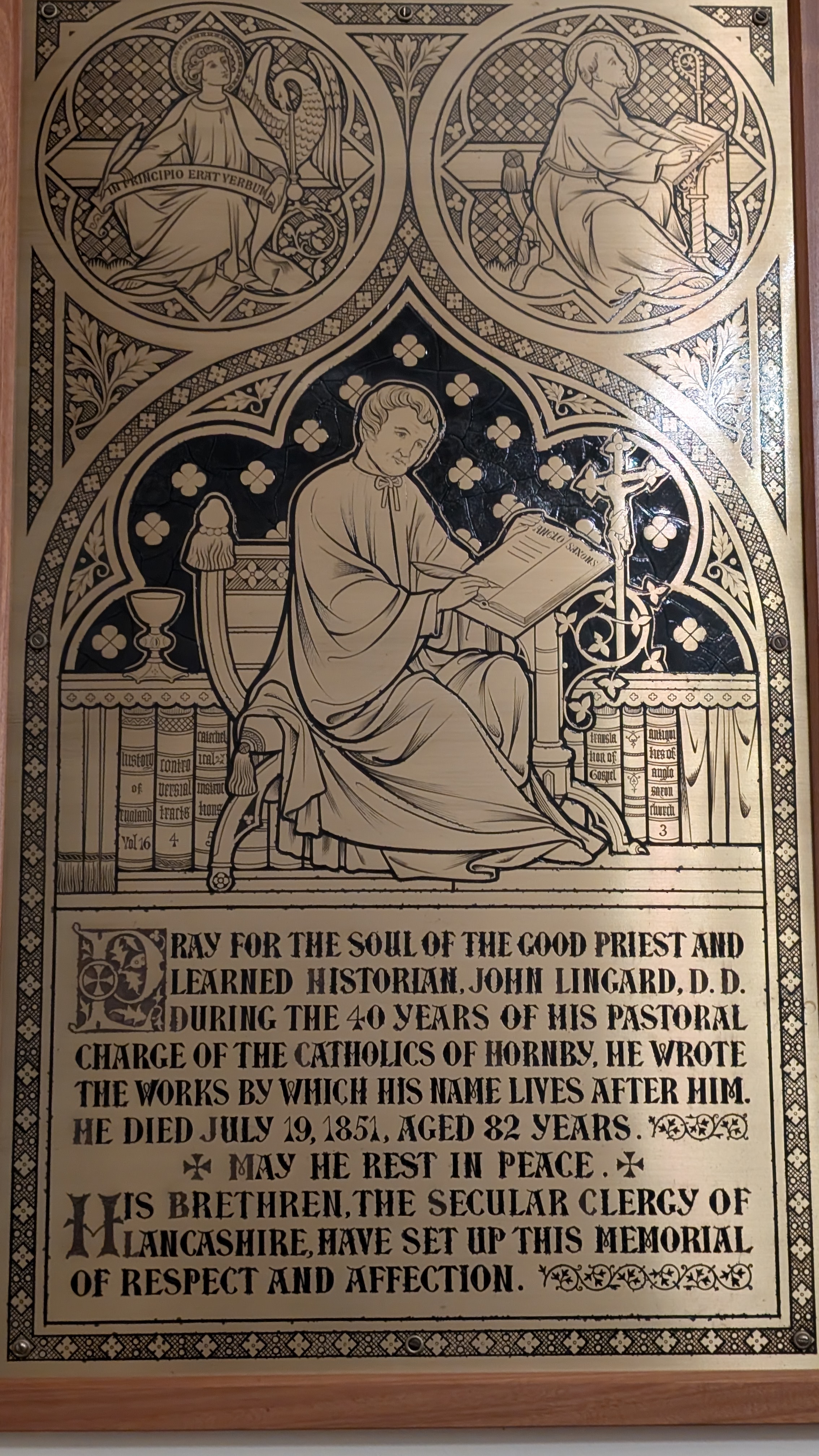
Following the upheavals of the Reformation, the Catholics of Lunesdale were served by priests from Robert Hall, near Bentham, home of the Cantsfield family. The parish of St. Mary's dates from 1762 when Mrs Ann Fenwick of Hornby Hall installed the newly-ordained priest Thomas Butler as her chaplain and established a chapel in the Hall to serve the Catholics of the district. After Ann's death in 1777 Hornby Hall reverted to the family of her late husband and the chapel was closed. In accordance with Ann's will and with funds left by her for the purpose, Thomas Butler bought a field adjoining Hornby Hall and in 1779 built a house in which was incorporated a chapel. This house is now the presbytery. In 1821 St Mary's church was built by Dr John Lingard, parish priest and historian, who lived in Hornby for forty years. He is commemorated by a brass plaque in St Mary's and also by a plaque in St Margaret's parish church, erected by his Anglican friends.
The style of St Mary's is simple and austere in the classical mode of the eighteenth century. The Venetian-style doorway of the porch matches the presbytery windows.
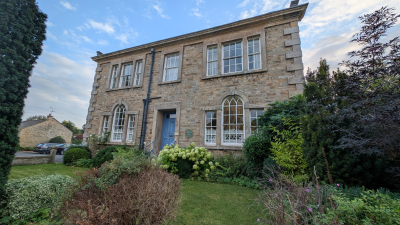 A list of the parish priests of St. Mary's can be found in the church porch. Overleaf are brief notes on Ann Fenwick and Dr Lingard. Details of the garden can be found on the storyboard in the car park. We hope you enjoy your visit to St Mary's.
Address: St Mary's Church, 59 Main Street, Hornby, Lancaster, LA2 8JT.
Ann Fenwick (1724 - 1777)
Ann Fenwick was born in 1724, the only child of an Anglican attorney of Lancaster, Thomas Benison, and his Catholic wife, Ann Dowbiggin. On the death of her father, when Ann was eleven, she inherited his estates, together with the newly-built Hornby Hall. From an uncle she inherited various mercantile interests and was owner of the ship 'The True Love'. Having completed her education (thought to have been at the Bar Convent, York), Ann settled with her mother at Hornby Hall and on coming of age took over management of her own affairs until, in 1752, she married John Fenwick of Burrow Hall, a local Protestant landowner. This 'marriage of true affection’1 came to a tragic end when John was killed in a hunting accident five years later.
As there were no children of the marriage and an act of Parliament banned Catholics from inheriting property, the whole of John's estates, which included the properties which Ann had brought to the marriage, were claimed by Thomas Fenwick, John's brother, a lawyer and member of Parliament. Thomas was persuaded by Ann's lawyers to make Ann an annuity and to permit her to live in Hornby Hall, and a document to this effect was drawn up. He failed to honour the agreement, however, and though some quite large payments were made, as seen from Ann's meticulous accounts, at times her affairs were at such a low ebb that she was unable to pay her servants. Her beloved mother died in 1762, never knowing of her daughter's difficulties, nor did Ann confide her troubles to any but her lawyers, for she did not wish to cause distress to her late husband's family.
After her mother's death, and in poor health, Ann travelled to Bath in order to take the waters, and records that she ‘had the honour to drink her glass with Mr Pitt at the Pump Room.’2 That same year Ann's long-desired wish was fulfilled and she was able to install Thomas Butler to serve as chaplain to her household and to the Catholics of the district.
In 1769 Ann, now declared bankrupt, was at last persuaded by her lawyers to seek redress through the courts of law. In 1770 an action was procured, before the King's Bench, to impel Thomas Fenwick to uphold the terms of the settlement and to pay his debts to her. This was to be done by the sale of some of his properties, but Thomas again invoked the act of 1701, and his claim was upheld. The case became a cause célèbre amid general indignation.
Ann now determined to take matters into her own hands and, on the advice of Lord Hardwick, she travelled to London to seek an interview with the Lord Chancellor, Lord Camden. Much struck by the injustice of her predicament, but unable to take the matter further through the courts, he brought a Private Bill before the House of Lords. There the injustice of the matter was unanimously deplored, and in 1772 an Act was passed which awarded Ann nearly £7000 and an annuity of £400 until her death.
Ann returned to her home at Hornby Hall where in spite of increasing ill health she continued to devote herself to her many charitable works, with a special care for children. She died in 1777 aged 53 and was buried with her parents in St Wilfrid's Church, Melling, in the main aisle before the chancel. Bishop Foley described her as 'an indomitable woman whose courageous fight for her inheritance, which as a papist she had forfeited, brought to light some of the disabilities under which Catholics were living and so helped to create a climate for toleration.’3 In 1778 the First Catholic Relief Act was passed.
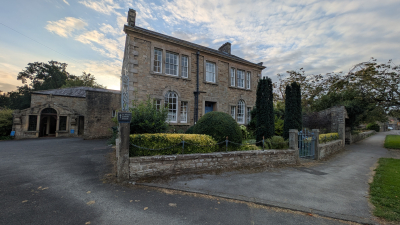 In her will Ann made provision for the continuance of spiritual care for the Catholics of Lunesdale, bequeathing to Thomas Butler the funds which allowed him to procure land next to Hornby Hall where, in 1779, he built the house/chapel which now serves as St Mary's presbytery.
John Lingard (1771-1851)
John Lingard was born in Winchester on 5 February 1771. His father John was a carpenter and his mother Elizabeth
(Rennell) was a farmer's daughter, both originally from Claxby in Lincolnshire, who had moved to Winchester to escape religious persecution. John was baptised and later confirmed by the Winchester priest James Nolan who, recognising in the boy extraordinary abilities, arranged a burse for him so that he could continue his education at the English College at Douay in Flanders. John entered Douay on 30 September 1782; sixty-five years later he wrote to a friend 'Deo gratias. I have always kept this day with a bottle of my best wine.’4 In 1790 he took the college oath and embarked upon his theological studies, but in 1793 Douay was occupied by French revolutionaries. John escaped with a party of lay students and returned to England.
After a year as a tutor to a son of Lord Stourton, John resumed his studies at Crook Hall, the seminary for the north of England, and was ordained priest at the Bar Convent in York in April 1795. Thereafter he continued as professor at Crook Hall, later becoming vice-president, and here he wrote Antiquities of the Anglo Saxon Church, published in 1806. Two years later the seminary moved to the newly completed St. Cuthbert's College at Ushaw near Durham. This was a time of turmoil in the religious and political affairs of England: the Second Catholic Relief Act had been passed in 1791 and Catholic priests were now permitted to say mass openly, but the move towards Catholic emancipation was met with strong anti-Catholic sentiment. Lingard realised that much of this fear and hatred was based on historical misinformation and propaganda. In 1811, declining a professorship at Maynooth, Lingard was appointed to the mission of Hornby. Here he wrote his History of England, from the first Invasion of the Romans to the Accession of William and Mary in 1688, searching for original documents throughout Britain and Europe (he was conversant in seven languages). His purpose was 'to find the truth [...] using rigorously the best methods and techniques available to exercise a professional and objective judgement.’5 In notes to the sixth edition of the History, published in 1849, he comments: 'I have strictly adhered to the same rules to which I subjected myself in the former editions; to admit no statement on trust, to weigh with care the value of the authorities on which I rely, and to watch with jealousy the secret workings of my own personal feelings and prepossessions.’6 Thus he 'created single-handedly the methodology of source criticism in English historical writing a very great achievement for which he deserves and should at last be given the full credit. It changed English historiography completely, providing the basis for the modern writing of history as an independent and fully professional discipline, in pursuit of the truth about the past.’7 The History comprised eight volumes printed between 1819 and 1830 and published in London and in America; there were seven English editions and also editions in French, German and Italian.
In 1821, with money from the sale of the first three volumes of his History, he built the little church of St. Mary. In 1822 a young cousin, William Hall, came to stay at St Mary's, his studies for the priesthood having been cut short by ill health. Hall died on 24 December 1825 and is buried beneath the sanctuary.
In addition to his History of England and Antiquities of the Anglo-Saxon Church, which he revised and republished in 1845, Lingard wrote many learned papers and had a wide correspondence. Honours came from all over Europe: Pope Pius VII conferred on him the triple doctorate of divinity and of canon and civil law, he was an Associate of the Royal College of Literature, a member of the Académie Francaise, and vice-president of the British Archaeological Association. In 1839 he was granted a pension of £300 from the privy purse of Queen Victoria by Lord Melbourne. Among his published works is the much-loved hymn Hail Queen of Heaven.
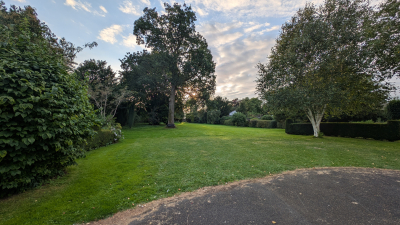 Dr Lingard loved his home in Hornby, once saying: 'here everything, every place, is endeared to me.’8 In addition to his writings, his continuing research and his pastoral duties he enjoyed the company of his friends the Murrays of Hornby Hall, Pudsey Dawson of Hornby Castle, and Rev Proctor, vicar of St Margaret's, and his successor Rev Fogg and his wife Elizabeth. He entertained to dinner the circuit judges and was acquainted with the poets Wordsworth and Southey. He delighted in the company of children and arranged a party for the village children each Christmas. He was an enthusiastic gardener, skilled in the grafting of his fruit trees and keen to try new varieties of vegetables. An acorn collected on a visit to Lake Trasimene in Italy and planted in 1821 marks the grave of his old horse Betty; this is the fine oak tree known as Lingard's Oak, now encircled by a metal seat. He had a special affection for animals; his Sicilian poodle Etna (Ettie) was a particular favourite, fetching his boots from upstairs and his breviary from the church (leaving tooth marks on the cover); Chitty the cat welcomed him on his return home. A tortoise accompanied his later years and lived on at the presbytery for thirty years more.
In the later years of his life he suffered greatly from an accumulation of illnesses and his eye-sight deteriorated, but he remained 'always cheerful, always resigned, always manifesting that vigour of intellect, that playfulness of thought, that kind, considerate, gentle disposition, which had endeared him throughout life to all who had possessed the happiness of his acquaintance.’9 He died on 17 July 1851, calm and conscious to the last, and was buried as he had wished, quietly and simply in the cemetery cloister of Ushaw College. 'This unassuming priest contributed significantly to a burgeoning confidence on the part of the English Catholic community [...] and laid the foundations for a renewal of historical studies reaching far into the future.’10
- Rt Rev B. C. Foley, Some People of the Penal Times (1991)
- Foley, Penal Times
- Foley, Penal Times
- M. Haile and E. Bonney, Life and Letters of John Lingard 1771-1851 (1911)
- Edwin Jones, John Lingard and the Pursuit of Historical Truth (2001)
- John Lingard, History of England, 6th edition (1849)
- Jones, Lingard
- Haile and Bonney, Lingard
- M. A. Tierney, Memoir of Dr. John Lingard (1855)
- Peter Phillips, John Lingard: Priest and Historian (2008)